
After PHP2Shell: A Month of Rising Web Supply Chain Risk
By Tim Benhart | November 27, 2026
Since PHP2Shell surfaced on October 20, the pace of serious web security incidents has climbed sharply, and the attacks have moved closer to the browser. In five weeks, attackers poisoned trusted vendor scripts on some of the largest sites on the internet, exploited core flaws in PHP and Drupal within days of disclosure, and took credentials and keys stored inside vendor platforms.
The common thread is trust. Most of these incidents did not start on the victim’s own servers. They started in a tag, a widget, a hosting platform or a library the victim relied on every day and rarely inspected.
By the numbers
The increase is measurable. In the first week of October we counted 4 significant web security incidents. In the week of November 17 we counted 21.
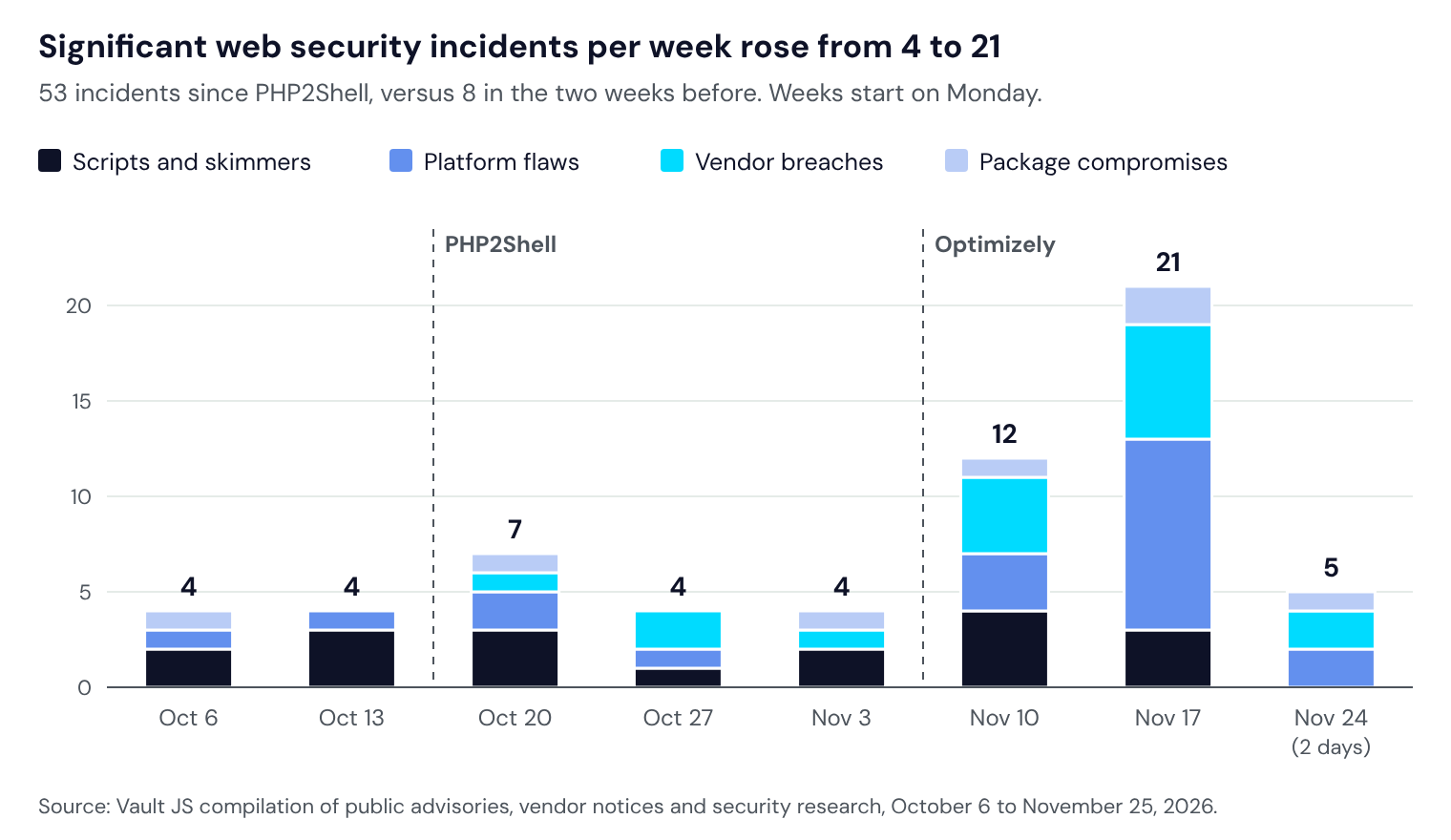
The late October rise came from PHP2Shell and a run of Shopify and Magento skimming campaigns. The November surge was broader: ten platform security advisories landed in a single week, alongside six vendor breach disclosures.
Trusted scripts turned hostile
The most damaging pattern of the month was threat actors turning trusted third-party JavaScript into a delivery channel. None of these attacks needed a change to the victim’s own code. The page simply started doing something new for every visitor.
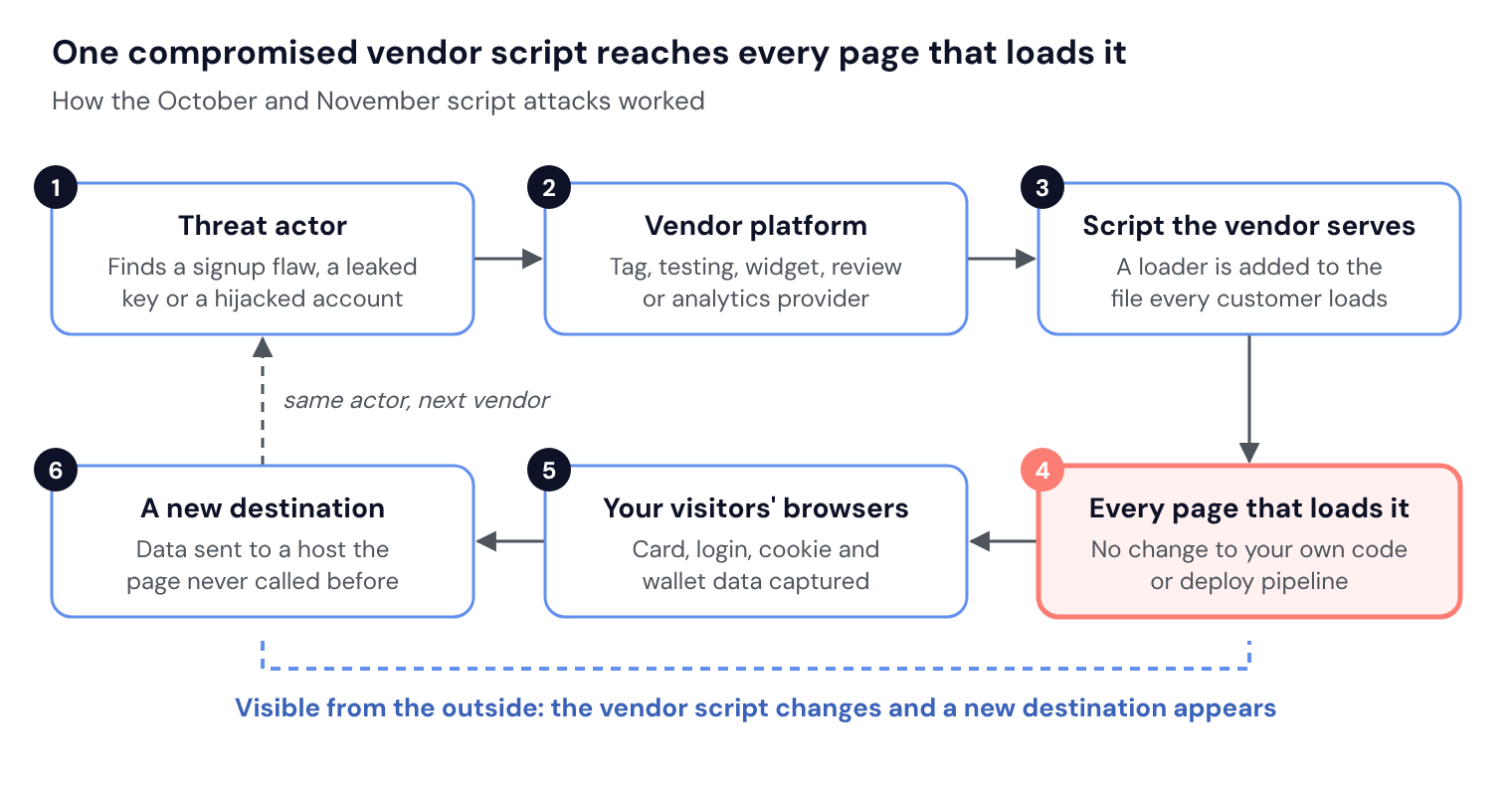
- Optimizely Web Experimentation, November 16. A flaw in the signup flow let an attacker add a loader to customer snippets. For most of a day, visitors to some of the best-known sites on the web received a card skimmer, a cookie and screenshot stealer, a crypto wallet swapper and iPhone exploit kits (Report URI, StepSecurity).
- The same actor, three more vendors. Researchers traced the same loader to Kissmetrics, StorifyMe and a Minute Media video loader between November 13 and 16 (Hudson Rock).
- Newspaper checkouts. A hosted subscription payment form loaded a skimmer on US news sites from November 13, sending card details out of the page (Guardio).
- Shopify apps. In mid October, several popular apps served scripts that swapped real checkouts for fake ones (Sansec).
- Forgotten tags. Abandoned analytics domains and tags left on sites for years were used to deliver iPhone spyware (Report URI).
Classic Magecart campaigns kept pace in the background, and several reached hundreds of stores at once (Sansec, Report URI). The largest, a Magento loader, reached 953 stores.
| Reported | Campaign | Reach |
|---|---|---|
| Oct 24 | Magento CMS block loader | 953 stores |
| Nov 12 | HexMage skimmer | 533 shops |
| Nov 16 | Optimizely snippet hijack | 178 organizations |
| Nov 5 | SuperPixel jQuery skimmer | 100+ shops |
| Nov 22 | Newspaper checkout skimmer | 80 news sites |
Public reports from Sansec, Report URI, Optimizely and Guardio, October 24 to November 22, 2026. Optimizely counts organizations; the SuperPixel figure is a minimum.
Platforms under pressure
Core web platforms shipped emergency fixes at a pace that left almost no gap between disclosure and attack. PHP2Shell set the tone: details leaked a day before the patches, probing was seen days earlier, and confirmed code execution followed within a week (Recorded Future, BleepingComputer).
| Date | Platform | What happened |
|---|---|---|
| Nov 25 | Drupal core | SA-CORE-2026-019: follow-on installer bypass, exploited; sites patched last week can still be affected |
| Nov 24 | Adobe Experience Manager | About 100 fixes, two code injection flaws rated 9.9 |
| Nov 23 | WordPress plugins | Hijacked developer account pushed backdoored builds of six plugins |
| Nov 19 | PHP | Second critical release in a month, 18 CVEs, including an FPM request smuggling flaw rated 9.2 |
| Nov 18 | Drupal core | SA-CORE-2026-017: installer flaw enabling site takeover, exploited within a day, added to CISA KEV |
| Nov 18 | NGINX | HTTP/2 remote code execution with a public proof of concept |
| Nov 18 | WordPress core | 7.1.5 fixes 20 issues, including unauthenticated privilege escalation |
| Nov 10 | React Server Components | Unauthenticated remote code execution, rated 9.5 |
| Oct 21 | Node.js | Brotli decoder flaw reachable with a crafted compressed stream, rated 9.2 |
| Oct 21 | PHP | PHP2Shell: two critical flaws in every supported version |
Open source packages were hit in parallel. Malicious releases of LiteLLM and Microsoft’s agent-framework on PyPI, and of WPPConnect and bee-js on npm, stole cloud keys and CI secrets from anyone who installed them in the wrong window (Aikido, Wiz).
Breaches in the vendors you trust
A growing share of incidents never touched a customer’s website at all. Attackers went after the platforms that host sites, store their secrets or hold their customers’ data, then left with keys that open everything else.
- Hosting and infrastructure. Acquia told customers to delete and reissue every credential stored in its environments after attackers copied configuration data from November 19 (Acquia). Radware disclosed that an exposed internal Cloud WAF API leaked customer cloud storage keys (BleepingComputer). In October, Railway and Zeabur reported intrusions that put customer secrets at risk in up to about 100,000 workspaces and more than 3 million stored environment variables (StepSecurity, WorkOS).
- Data platforms. Stolen credentials for a data platform vendor were used to reach customer AWS accounts (Wiz), and an extortion group soon claimed data from major card networks, banks and retailers, several of which confirmed vendor-side breaches.
- Marketing and commerce vendors. KARTE suspended all services after leaking 79,249 account emails and integration credentials. MoEngage confirmed access to client app user data, clients of Plotline and Soapbox Engage reported exposed customer records, and Cleverbridge confirmed theft of stored card numbers and CVVs.
- People, not code. A new extortion crew is calling employees and phishing SSO logins and MFA approvals at large enterprises (Okta).
You cannot see a vendor’s database from your own pages. You can see when the script that vendor serves on your pages starts to behave differently, and you can know exactly which vendors are present before the breach notice arrives.
What to do now
The fixes are rarely exotic. The hard part is knowing, quickly and with evidence, what is actually running on your properties when the next notice lands. Speed matters, because the damage starts in minutes.
| Time live | Compromised script or package | Note |
|---|---|---|
| About 50 minutes | Polymarket monitoring script | About $2.6M stolen |
| 68 minutes | LiteLLM PyPI release | |
| About 19 hours | Optimizely snippets | |
| About 2 days | StorifyMe widgets | |
| About 3 days | Fandango checkout skimmer | |
| About 6 days | Newspaper checkout skimmer |
Time each compromised script or package was live before removal. Public reports from Report URI, Aikido, Optimizely, StorifyMe, Fandango and Guardio. Durations are approximate.
- Know every third party. Keep a current inventory of the scripts, tags, pixels and SDKs on your web, mobile and Connected TV properties, including the ones nobody remembers adding. Remove tags for vendors you no longer use.
- Watch for change, not just presence. A trusted vendor turned hostile looks like a known script that suddenly calls a new domain or sends form, card or cookie data somewhere new. Checkout, login and account pages deserve the closest attention.
- Patch the platform under the page. Confirm PHP, Drupal, WordPress, AEM and your web servers are on fixed releases. For Drupal, run update.php and keep the installer unreachable after patching.
- Rotate what vendors hold. After any vendor breach notice, delete and reissue the API keys, tokens and passwords stored in that vendor’s platform, then review the logs where those credentials are used.
- Harden the people layer. Move SSO to phishing-resistant MFA such as passkeys or FIDO2 keys, and brief help desks on phone-based social engineering.
- Keep the receipts. Record what your pages loaded and when. When a vendor discloses an incident, you will be asked whether you were affected. Evidence answers that in minutes instead of weeks.
How Vault JS helps
Your data is only as safe as your third-party Martech connections. Vault JS is an independent, third-party privacy compliance monitoring platform that gives enterprises continuous visibility into every script, tag and SDK running across their web, mobile and Connected TV properties.
- See the origin of every script. Know which vendors load on which pages, what each one calls, and where the data goes.
- Find it first. Continuous monitoring flags new or changed scripts, new destinations and unexpected data sharing, so your team hears about a change before a researcher, regulator or customer does.
- Get a technical to-do list. Each finding names the page, the vendor and the fix, so security and marketing teams can act on the same facts.
- Keep audit-ready evidence. When the next vendor notice arrives, you can show exactly what your pages loaded, when, and whether a malicious host ever appeared.
All of it runs without installing any code on your site. We see third-party risks; we don’t become one.
If the last five weeks raised questions about what is running on your properties, talk to your Vault JS team or contact us for a review of your third-party footprint.
Sources
- Optimizely: Report URI and StepSecurity
- Kissmetrics, StorifyMe and Minute Media: Hudson Rock
- Newspaper checkout skimmer: Guardio
- Shopify apps: Sansec
- Forgotten tags: Report URI
- Magento loader and HexMage: Sansec and Report URI
- PHP2Shell: Recorded Future and BleepingComputer
- LiteLLM and agent-framework: Aikido and Wiz
- Acquia: Acquia
- Radware: BleepingComputer
- Railway and Zeabur: StepSecurity and WorkOS
- Data platform credentials: Wiz
- Phone and SSO phishing: Okta
Incident counts are based on Vault JS research, compiled from public advisories, vendor notices and security research published between October 6 and November 25, 2026. This post is general information, not legal advice.
Recent Posts

Can Your Website Be Sued Under the VPPA? Video Privacy Lawsuits in 2026
Can a website be sued under the VPPA? Yes, if it shares what a viewer watched with a third party without the consent the law...
Read More
Does the VPPA Apply to a Website With Video and a Meta Pixel?
The Video Privacy Protection Act can reach any website, mobile app or CTV app that plays video and shares viewing data through a pixel or...
Read More
What Are the Biggest Privacy Fines and How Can Businesses Avoid Them?
The largest privacy fines and settlements on record, updated through November 2026, plus the smaller actions against ordinary brands over how their websites and apps...
Read More