
Does the VPPA Apply to a Website With Video and a Meta Pixel?
By Julie Oberweis, COO, Co-Founder, Vault JS | November 25, 2026
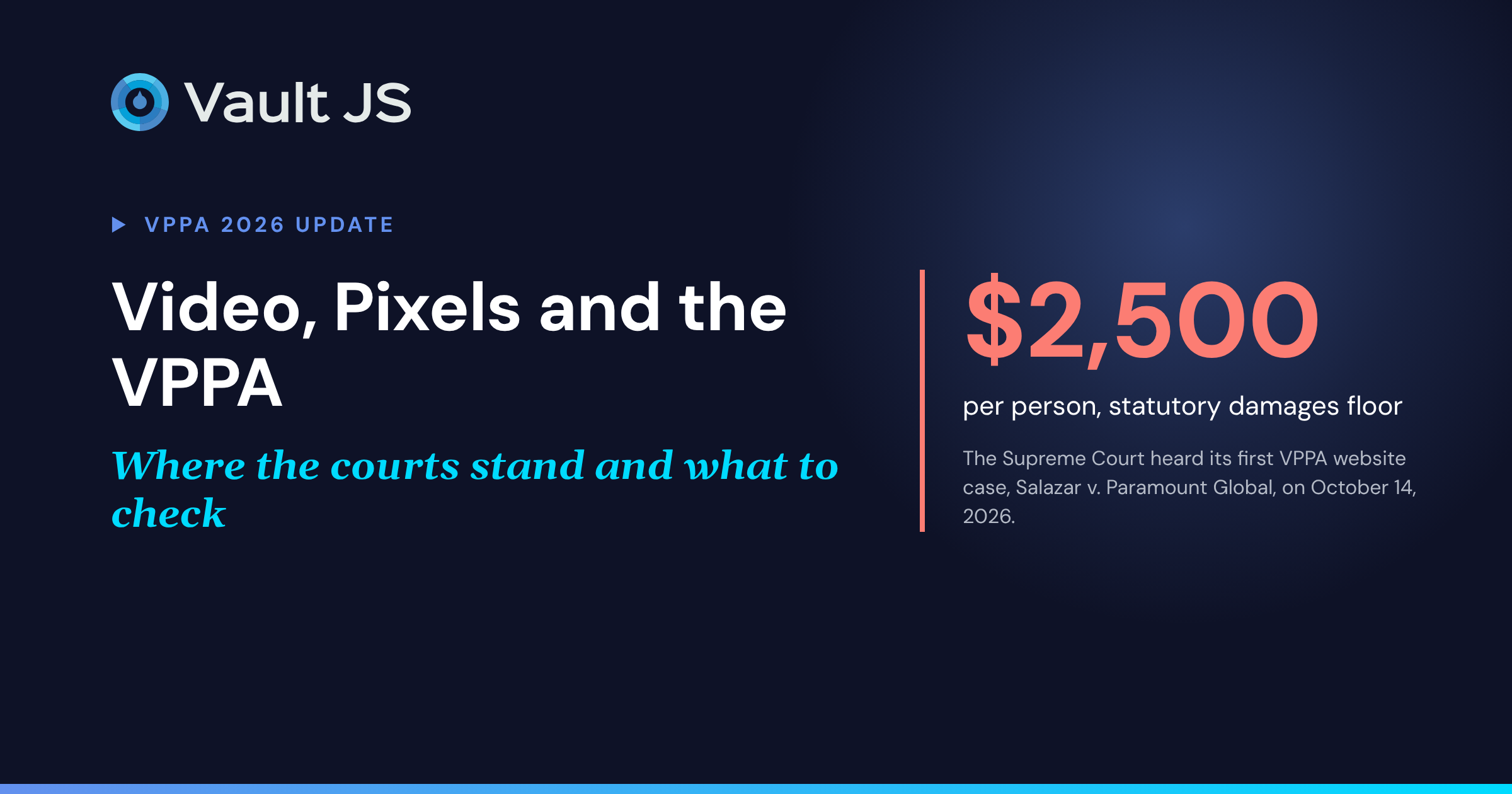
Key Takeaways
- Yes, it can. The Video Privacy Protection Act (VPPA) is not limited to streaming services. The typical claim is against an ordinary website, mobile app or connected TV (CTV) app that plays video while a digital tracking technology (DTT) such as the Meta Pixel sends the video title or URL, together with an identifier, to a third party without the specific consent the statute requires.
- The answer depends on the court. The Second Circuit has shut down most Meta Pixel claims since Solomon v. Flipps Media (May 2025). District courts in California and elsewhere have let very similar claims go forward. The appeals courts also disagree about who counts as a “consumer.”
- The Supreme Court is now involved, but only on one question. It heard Salazar v. Paramount Global on October 14, 2026 and has not ruled. Whatever it decides, the practical work is the same: know what your video pages and screens send, to whom, and under what consent.
This post was first published in December 2023 and updated in November 2026.
When I first wrote about the VPPA in 2023, the point was simple: a 1988 law was being used against enterprise websites that had nothing to do with video rental. What has changed is the case law. Six federal appeals courts have ruled on the statute’s scope since late 2024, they do not agree with each other, and the Supreme Court heard argument in a VPPA case last month.
The statute itself is short. Under 18 U.S.C. § 2710, a “video tape service provider” may not knowingly disclose information that identifies a consumer as having requested or obtained specific video materials. Consumers can sue directly. A court may award actual damages with a floor of $2,500 in liquidated damages, plus punitive damages and attorneys’ fees. Consent counts only if it is informed, written, and in a form distinct and separate from other legal or financial terms. Congress last amended the law in January 2013.
Does the VPPA apply to a website with video and a Meta Pixel?
It can. The usual fact pattern: a visitor who is logged in to Facebook watches a video on your site. The Meta Pixel on that page sends Meta the page URL or video title along with the visitor’s Facebook ID from the c_user cookie. The plaintiff says that is a disclosure of identifiable viewing information without VPPA consent.
Whether that claim survives a motion to dismiss turns on three questions: whether you are a “video tape service provider,” whether the visitor is a “consumer,” and whether what the DTT sent is “personally identifiable information.” Courts have mostly read the first one broadly. In Cole v. LinkedIn (N.D. Cal., October 20, 2025), the court said video need not be a company’s main focus. Movie theaters are the exception. The Eighth and Ninth Circuits both held in 2025 that theaters are not covered. The courts split on the other two questions.
Who counts as a "consumer" under the VPPA?
The statute defines a consumer as a “renter, purchaser, or subscriber of goods or services from a video tape service provider.” The fight is over whether those goods or services have to be video.
The Second Circuit said no in Salazar v. NBA (October 15, 2024). A free email newsletter sign-up was enough. The Seventh Circuit agreed in Gardner v. Me-TV (March 28, 2025), where the plaintiffs had given an email address and zip code to create an account. The Sixth Circuit went the other way in Salazar v. Paramount Global (April 3, 2025), holding that a newsletter subscriber is not a consumer unless the subscription is for audiovisual goods or services. The D.C. Circuit reached a similar result in Pileggi v. Washington Newspaper Publishing (August 12, 2025).
The Supreme Court took the Sixth Circuit case on January 26, 2026 and heard argument on October 14, 2026. A decision is expected by June 2027. I will not guess at the outcome. The question presented is limited to the word “consumer.” It does not ask what counts as personally identifiable information.
What counts as "personally identifiable information"?
This question matters most for pixels, and it is not before the Supreme Court. The First Circuit asks whether the disclosure is reasonably and foreseeably likely to reveal what a person watched. The Second, Third and Ninth Circuits ask whether an ordinary person could use the information to identify someone’s viewing.
In Solomon v. Flipps Media (May 1, 2025), the Second Circuit applied the ordinary person test to the Meta Pixel and affirmed dismissal. Its reasoning: an ordinary person could not read a video title out of the Pixel’s coded request or connect a Facebook ID to a named person. The court repeated that result in Hughes v. NFL (June 20, 2025) and Golden v. NBCUniversal (April 23, 2026). The Supreme Court declined to review Solomon on December 8, 2025 and Hughes on March 9, 2026. A petition in Golden is pending, with NBCUniversal’s response due December 23, 2026.
Outside the Second Circuit the same test has produced the opposite result. In Cole v. LinkedIn, a California federal court held that sending video URLs together with a Facebook ID plausibly disclosed personally identifiable information. The same Meta Pixel on a video page can be a dismissed case in one courthouse and a live class action in another.
Which VPPA decisions matter most right now?
These are the rulings legal and marketing technology teams should know.
| Date | Case and court | Outcome | Why it matters |
|---|---|---|---|
| April 29, 2016 | Yershov v. Gannett, First Circuit | Claim allowed to proceed. A news app sent Adobe the video title, GPS location and Android ID. | Mobile apps are covered. The First Circuit uses the broader ’reasonably and foreseeably likely’ test for identifying information. |
| November 29, 2017 | Eichenberger v. ESPN, Ninth Circuit | Dismissal affirmed. A Roku serial number plus videos watched was not identifying. | Set the ’ordinary person’ test in the Ninth Circuit and shows how CTV device IDs are treated. |
| October 15, 2024 | Salazar v. NBA, Second Circuit | Dismissal vacated. A free newsletter subscriber can be a ’consumer.’ | Widened who can sue. Supreme Court review denied December 8, 2025. The trial court dismissed again on October 6, 2025 on the identifying-information question. A second appeal was argued June 16, 2026. No decision had been reported as of November 18, 2026. |
| March 28, 2025 | Gardner v. Me-TV, Seventh Circuit | Dismissal reversed. Signing up with an email and zip code made viewers subscribers. | The goods or services subscribed to do not have to be video. |
| April 3, 2025 | Salazar v. Paramount Global, Sixth Circuit | Dismissal affirmed. A newsletter subscriber is not a consumer unless the subscription is audiovisual. | Created the split. This is the case now before the Supreme Court. |
| May 1, 2025 | Solomon v. Flipps Media, Second Circuit | Dismissal affirmed. Meta Pixel data was not identifying to an ordinary person. | Closed most Meta Pixel claims in the Second Circuit. Supreme Court review denied December 8, 2025. |
| August 12, 2025 | Pileggi v. Washington Newspaper Publishing, D.C. Circuit | Dismissal affirmed. A newsletter subscriber was not a consumer of the site’s free videos. | Goes further than the Sixth Circuit. A petition for Supreme Court review, filed February 27, 2026, has not been ruled on. |
| October 20, 2025 | Cole v. LinkedIn, N.D. California | Motion to dismiss denied. Video URLs sent with a Facebook ID plausibly identify a viewer. | Same ordinary person test as the Second Circuit, opposite result. Video need not be the company’s main business. |
| April 23, 2026 | Golden v. NBCUniversal, Second Circuit | Dismissal affirmed in a summary order on a Today.com Meta Pixel claim. | The Second Circuit is holding its position. A petition asks the Supreme Court to take up the identifying-information question. A response is due December 23, 2026. |
| October 14, 2026 | Salazar v. Paramount Global, U.S. Supreme Court | Argued. No decision yet. | Limited to the ’consumer’ question. A decision is expected by June 2027. |
What does Vault JS research show about VPPA cases?
Vault JS maintains a database of US privacy lawsuits. Based on Vault JS research, it holds nearly 300 records where the VPPA is the main statute. About 200 of those are decisions or settlements dated 2022 or later, and the count has risen every year, from fewer than 10 in 2022 to about 70 in 2025. Our 2026 records are still being added. These are court outcomes, not filings, so treat the numbers as a floor.
Three patterns stand out in the records since 2022:
- Nearly all are class actions. About nine in ten.
- Meta is the vendor named most often. The Meta Pixel or another Meta technology appears in about three in four. Google technologies appear in about one in six.
- Defendants win often, but not most of the time. Where the outcome is recorded, the defendant prevailed a little under half the time. The rest were plaintiff wins at that stage, settlements or mixed results.
Settlements are real money, and not only for streaming services. Publicly reported VPPA settlements include Tubi at $19.99 million, Crunchyroll at $16 million, AARP at $12.5 million, Patreon at $7.25 million and GameStop at $4.5 million. The AARP settlement received final approval on February 20, 2026. GameStop’s, over the Meta Pixel on a retail site, was approved in October 2025.
Does the VPPA cover mobile apps and connected TV apps?
Yes. Two foundational appellate decisions were not about websites at all. In Yershov v. Gannett (First Circuit, 2016), the USA Today mobile app sent Adobe the video title, the device’s GPS coordinates and its Android ID. The court let the claim proceed. In Eichenberger v. ESPN (Ninth Circuit, 2017), an ESPN channel on Roku sent Adobe the Roku device serial number and the videos watched. The court held that was not personally identifiable information under the ordinary person test.
The statute applies to an SDK in an app or a CTV channel the same way it applies to a pixel on a web page. What differs is the identifier. An email address, name or login ID sent with a video title is harder to defend than a device serial number on its own.
What should teams do now?
None of this requires waiting for the Supreme Court. Teams can run these checks this quarter.
- List every page and screen that plays video. Include product pages, help centers, blog posts with embedded players, mobile app screens and CTV apps.
- Record what loads there. Capture every third-party DTT that fires: pixels, tags, SDKs and embedded players from outside vendors.
- Look at what leaves. Inspect the outgoing requests. Is a video title, video ID or a URL that reveals the title being sent? Is an identifier going with it, such as a Facebook ID cookie, hashed email, login ID, advertising ID or device ID? The two together is the pattern plaintiffs plead.
- Check when it fires. Confirm whether those DTTs fire before the visitor makes a consent choice, and whether they stop after an opt-out. The VPPA describes a separate written consent, so ask counsel whether your banner or sign-up flow meets it.
- Review account, newsletter and login flows. In the Second and Seventh Circuits, a free sign-up can make a visitor a “consumer.” Know which viewers are also registered users.
- Decide whether the DTT belongs on the page. Removing a marketing pixel from video pages is often simpler than defending it. Patreon’s settlement required exactly that.
- Keep dated records. Tags change without notice. Keep a history of what your video pages sent and when you fixed it.
How does Vault JS help?
Vault JS is an independent, third-party privacy compliance monitoring platform for enterprise web, mobile and CTV properties. It continuously scans pages and screens that play video, documents which DTTs load, what data they send and whether they fire before consent, and gives teams a prioritized technical to-do list with dated evidence. Vault JS observes and documents. It is not a consent management platform or a law firm.
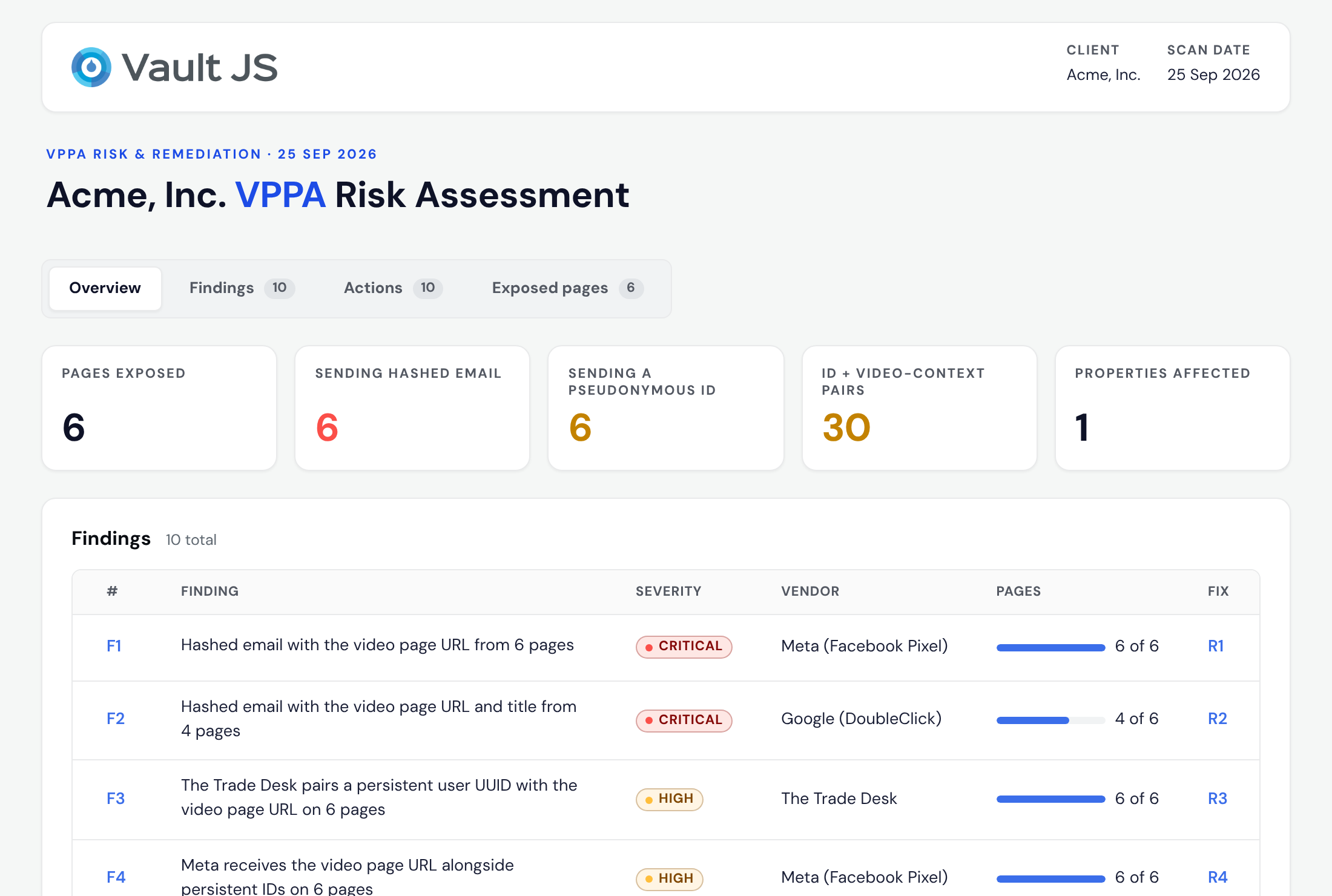
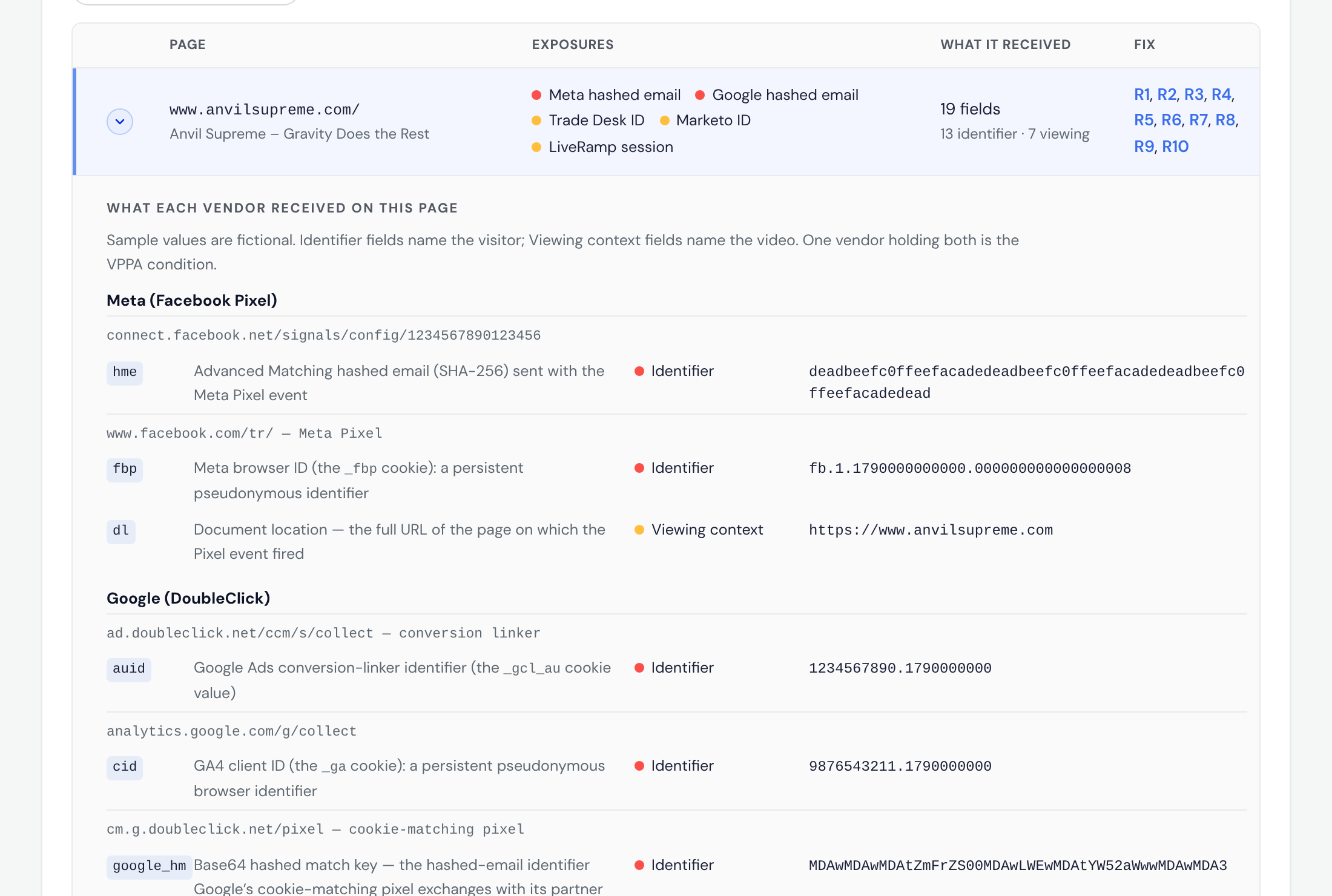
Sample VPPA Risk Assessment report. The company, pages and identifier values shown are fictional.
If you want to see what your own video pages send, Vault JS offers a complimentary review of a sample of your video pages. Request one here.
Sources
- 18 U.S.C. § 2710, Video Privacy Protection Act (Cornell Legal Information Institute)
- Supreme Court docket No. 25-459, Salazar v. Paramount Global
- SCOTUSblog, “Court to hear argument on how a video privacy law applies in the internet age” (October 12, 2026)
- Salazar v. Paramount Global, No. 23-5748 (6th Cir. April 3, 2025)
- Salazar v. National Basketball Association, No. 23-1147 (2d Cir. October 15, 2024) and Supreme Court docket No. 24-994
- Duane Morris, Salazar v. NBA dismissal on remand (S.D.N.Y. October 6, 2025)
- Gardner v. Me-TV National Limited Partnership, No. 24-1290 (7th Cir. March 28, 2025)
- Solomon v. Flipps Media, Inc., No. 23-7597 (2d Cir. May 1, 2025) and Supreme Court docket No. 25-228
- Supreme Court docket No. 25-868, Hughes v. National Football League
- Supreme Court docket No. 25-1040, Pileggi v. Washington Newspaper Publishing Co.
- Supreme Court docket No. 26-398, Golden v. NBCUniversal Media
- Yershov v. Gannett Satellite Information Network, No. 15-1719 (1st Cir. April 29, 2016)
- Eichenberger v. ESPN, Inc., No. 15-35449 (9th Cir. November 29, 2017)
- WilmerHale, “2025 Year in Review: Video Privacy Protection Act Litigation Trends” (January 23, 2026)
- WilmerHale, “Two Circuits Narrowly Construe the Video Privacy Protection Act” (October 20, 2025)
- Finnegan, “Recent Developments in Video Privacy Protection Act Litigation” (April 3, 2026)
- Markels v. AARP, No. 4:22-cv-05499 (N.D. Cal. February 20, 2026), order granting final approval
- Stark v. Patreon, Inc., No. 22-cv-03131 (N.D. Cal. June 5, 2025), order granting final approval
- Gregory v. Tubi, Inc. (Ill. Cir. Ct., Winnebago County), final approval order; Beltran v. Sony Pictures Entertainment d/b/a Crunchyroll, No. 1:22-cv-04858 (N.D. Ill. January 17, 2024), final approval order; GameStop settlement website
- Duane Morris via Legal 500, “Foul Play? Sports Fan Data Is Fueling the Next Class Action Boom” (November 16, 2026)
- Vault JS research: Vault JS privacy case database, queried November 18, 2026
This post is for general information only and is not legal advice. Vault JS is not a law firm. Talk to your own counsel about how the VPPA applies to your properties.
Recent Posts
What Are the Biggest Privacy Fines and How Can Businesses Avoid Them?
The largest privacy fines and settlements on record, updated through November 2026, plus the smaller actions against ordinary brands over how their websites and apps...
Read More
Mobile privacy enforcement is going global
In ten weeks, regulators and courts in seven jurisdictions judged mobile apps by what they did after the user made a choice. What FNAC, BBVA,...
The Xandr fine: responsibility does not travel with the bid request
Norway's largest data protection fine went to the ad exchange, not the app. Why Xandr's assumed-consent defense failed, and what app owners should check this...