
What Are the Biggest Privacy Fines and How Can Businesses Avoid Them?
By Julie Oberweis, COO, Co-Founder, Vault JS | November 18, 2026
Key Takeaways
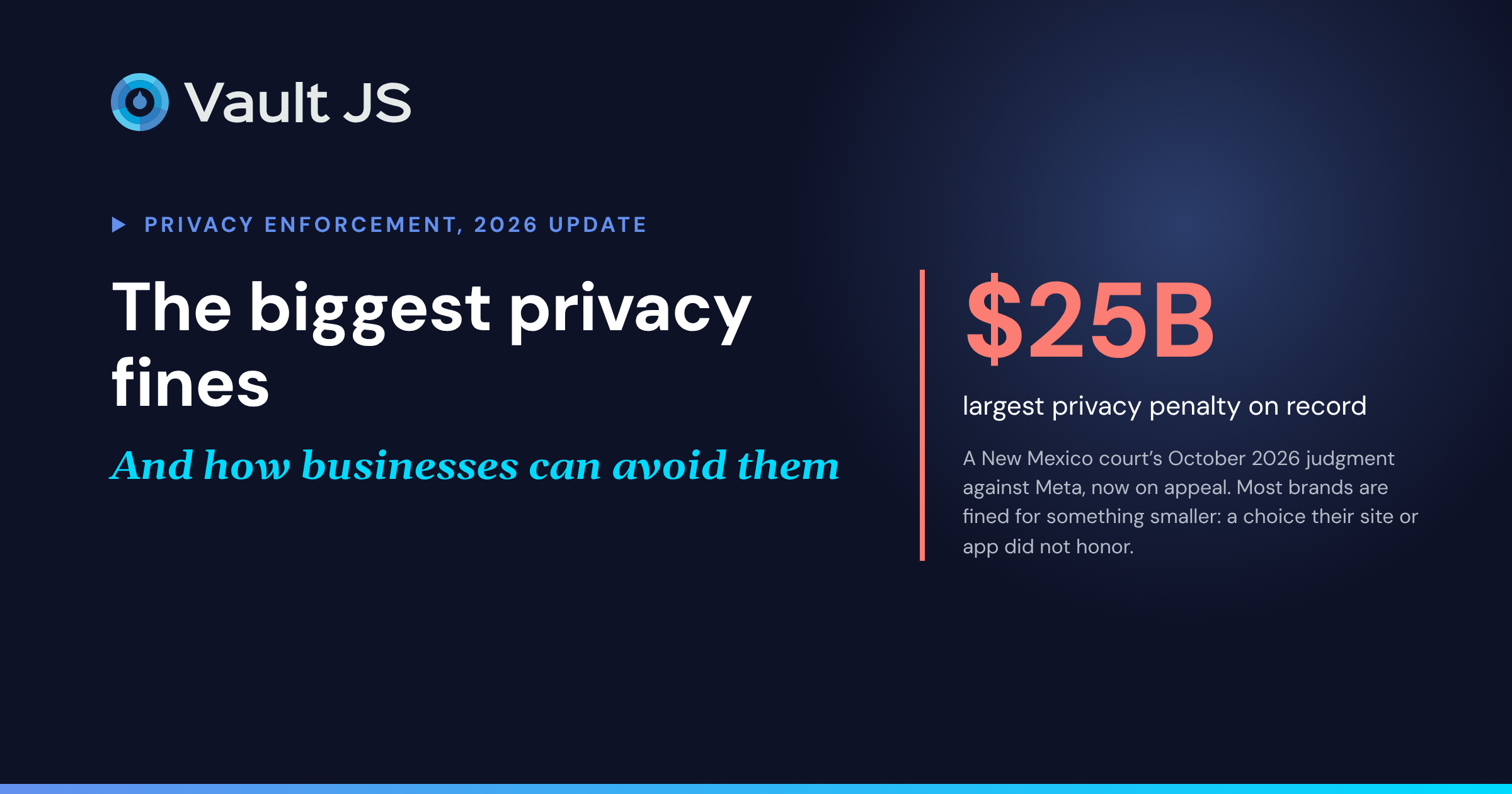
- The largest privacy penalties now run into the tens of billions. In October 2026 a New Mexico court ordered Meta to pay $25 billion for misleading Facebook users about their data, two months after Meta agreed to pay about $18 billion to state attorneys general over children’s data and teen safety. In Europe, Uber was fined €825 million in August 2026 and Meta €805 million in November. Several of these are under appeal.
- Most brands are not fined for a breach. They are fined for how their websites and apps behave. General Motors ($12.75 million, the largest CCPA penalty so far), FedEx ($2.975 million), Disney ($2.75 million), Lyft ($1.8 million), Healthline and Hertz ($1.55 million each) and Tractor Supply ($1.35 million) all paid over opt-outs that did not work or data sold without proper notice. In Europe, SHEIN (€150 million) and FNAC (€7 million) were fined because DTTs kept running after visitors said no.
- Regulators now test what a site or app does after the user makes a choice, and California no longer gives companies an automatic window to cure a violation. The companies that fare best find their own problems first, fix them quickly, and keep evidence that the fix worked.
Updated November 2026. This post was first published in August 2023 and has been rebuilt with enforcement actions through November 2026.
When we first wrote this post in 2023, Sephora’s $1.2 million fine was groundbreaking. It was the first penalty under the CCPA, and the first time a company was fined for ignoring an opt-out signal sent by the visitor’s browser. Three years later that case reads like the opening move. Privacy penalties have grown at the top, and they have spread well beyond Big Tech. Automakers, retailers, publishers, banks, grocery chains and ride-share apps have all been fined or have settled since.
This post covers two lists. The first is the largest privacy fines and settlements on record. The second matters more to most companies: the actions against ordinary brands over what their websites and apps did with customer data. Then we look at what those cases have in common and how to stay off both lists.
What are the biggest privacy fines and settlements?
These are the largest privacy penalties and government settlements announced as of November 2026, ordered roughly by size. The list is based on Vault JS research: our database of privacy enforcement actions and court decisions, checked against regulator and attorney general announcements. It covers government actions only, so private class actions are left out. Amounts are as announced, and several are under appeal or waiting for court approval.
| Amount | Company | Authority and date | What it was for |
|---|---|---|---|
| $25B | Meta | New Mexico state court, Oct 2026 | Misleading Facebook users about who could access their data, in a case brought by the state attorney general after Cambridge Analytica. Meta says it will appeal |
| About $18B | Meta | State attorneys general, Aug 2026 | Up to $17.1 billion to a coalition of 51 attorneys general and more than $1 billion to Texas, over harm to young users and children’s data. About $5 billion is contingent |
| $5B | Meta (Facebook) | FTC, July 2019 | Violating an earlier FTC privacy order, after Cambridge Analytica |
| $1.4B | Meta | Texas Attorney General, July 2024 | Capturing facial biometric data without consent |
| $1.375B | Texas Attorney General, May 2025 | Location tracking, Incognito browsing data and biometric identifiers | |
| €1.2B | Meta | Irish DPC, May 2023 | Transferring EU users’ data to the US without adequate protection |
| RMB 8.026B (about $1.2B) |
Didi | Cyberspace Administration of China, July 2022 | Unlawful collection of passenger and driver data, including location and facial recognition data |
| €825M | Uber | Dutch AP, Aug 2026 | Deactivating drivers’ accounts by automated decision without human review. Uber says it will appeal |
| €805M | Meta | Garante (Italy), Nov 2026 | The Facebook Android app accessed the photo galleries of about 20 million Italian users without specific consent |
| Up to $700M | Equifax | FTC, CFPB and states, July 2019 | Security failures behind a breach of about 147 million people’s records |
| €530M | TikTok | Irish DPC, May 2025 | Access to European users’ data from China |
| $520M | Epic Games | FTC, Dec 2022 | $275 million for children’s privacy violations in Fortnite and $245 million in refunds over deceptive design |
| KRW 624.7B (about $409M) |
Coupang | Korea PIPC, June 2026 | A breach affecting 37.5 million people, plus tracking members across third-party sites and apps. A court has since suspended the tracking portion while Coupang appeals |
| €405M | Meta (Instagram) | Irish DPC, Sept 2022 | Teenagers’ contact details exposed and accounts public by default |
| €403M | Irish DPC, Sept 2026 | Processing location data without a valid basis. Google is challenging the fine | |
| $400M | TikTok | US Justice Department for the FTC, Aug 2026 | Children’s privacy violations under COPPA. $100 million of it depends on a further court order |
| $391.5M | 40 state attorneys general, Nov 2022 | Misleading users about when location tracking was switched on | |
| €390M | Meta | Irish DPC, Jan 2023 | Relying on its terms of service as the legal basis for behavioral advertising |
| €345M | TikTok | Irish DPC, Sept 2023 | Children’s accounts set to public by default |
| €325M | CNIL (France), Sept 2025 | Ads shown in Gmail and cookies set at account creation without valid consent | |
| €310M | Irish DPC, Oct 2024 | Behavioral advertising without a valid legal basis |
Three things stand out. First, one company accounts for eight of the 21 entries, including the four largest. Second, the biggest numbers in the US now come from the states, not federal agencies. New Mexico won its judgment in state court, and Texas alone has secured more than $3.7 billion from Meta and Google across three settlements. Third, many of these amounts are not final. Meta is appealing the New Mexico judgment, Uber and Google are contesting their fines, and Amazon’s €746 million fine from 2021, long the second largest under the GDPR, was annulled by a Luxembourg court in March 2026 and sent back to the regulator, although the court agreed with most of the underlying findings.
One judgment is left out on purpose. A New Mexico court also ordered Meta to pay $942 million in 2026 in a child-safety case, which was not mainly about privacy.
Which privacy fines have hit ordinary brands?
The billion-dollar cases involve a handful of platforms. The cases below involve the kind of company most of our readers work for. None of them started with a data breach. Each one came down to what a website or app actually did with customer data.
| Amount | Company | Authority and date | What it was for |
|---|---|---|---|
| $220M | General Motors | 36 attorneys general, Oct 2026 | Selling driving and location data that reached insurers, with drivers enrolled without clear consent |
| €150M | SHEIN | CNIL (France), Sept 2025 | Cookies placed before consent and kept after visitors refused |
| $12.75M | General Motors | California AG and CalPrivacy, May 2026 | Selling OnStar driving and location data without notice. Largest CCPA penalty to date and the first data minimization case |
| NOK 92M (about €8.6M) |
Xandr | Datatilsynet (Norway), Oct 2026 | Passing app users’ data through ad auctions without a legal basis |
| €7M | FNAC | CNIL (France), Oct 2026 | A tracker in the mobile app kept running after users declined |
| €5.5M | BBVA | Garante (Italy), Sept 2026 | In-app marketing continued after a customer switched it off |
| $2.975M | FedEx | CalPrivacy, Nov 2026 | Advertising DTTs ran on its website while its privacy policy said it did not sell or share data, and Global Privacy Control was not honored |
| $2.75M | Disney | California AG, Feb 2026 | Opt-outs were not applied across devices and services |
| $1.8M | Lyft | California AG, Oct 2026 | No way to opt out of the sale of data inside the app |
| $1.55M | Hertz | CalPrivacy, Nov 2026 | The Hertz, Dollar and Thrifty websites did not honor Global Privacy Control, and DTTs from 13 ad tech companies kept sharing data |
| $1.55M | Healthline | California AG, July 2025 | Opt-outs, including Global Privacy Control, were not honored for targeted advertising |
| $1.35M | Tractor Supply | CalPrivacy, Sept 2025 | The site did not recognize Global Privacy Control signals |
| $1.2M | Sephora | California AG, Aug 2022 | The first CCPA penalty, also over Global Privacy Control |
| $632,500 | Honda | CalPrivacy, March 2025 | Opt-out requests were harder than they should be, and the cookie banner made accepting easier than refusing |
These amounts are smaller, but they come with multi-year compliance obligations, and they tend to set the pattern for the next round of cases. Private lawsuits add to the total. Plaintiffs have filed thousands of wiretap claims over website pixels and session replay, which we cover in our analysis of 318 CIPA decisions. Mobile apps are now getting the same attention, as we describe in Mobile privacy enforcement is going global.
What gets companies fined?
Privacy laws differ by country and state, but the same six problems come up again and again in the cases above.
- A choice that never reaches the code. The visitor opts out, declines cookies or sends a Global Privacy Control signal, and the DTTs on the page keep collecting anyway. This is the pattern behind Sephora, Healthline, Tractor Supply, Hertz, FedEx, Disney, SHEIN and FNAC.
- Selling or sharing data people did not knowingly agree to. General Motors sold driving data that ended up with insurers. Xandr passed app users’ data through ad auctions on the assumption that someone else had collected consent. See our post on the Xandr fine.
- Children’s and teens’ data. Meta and TikTok agreed to more than $18 billion in settlements in August 2026 alone, and regulators in Brazil and Texas have brought their own cases.
- Moving data across borders without protection. Meta and TikTok were each fined for transfers out of Europe, as was Uber (€290 million, Dutch AP, 2024).
- Automated decisions about people. Uber’s €825 million fine was for deactivating drivers’ accounts by algorithm without a person reviewing the decision.
- Basic security failures. Coupang’s record fine in Korea followed a breach traced to poorly managed access keys. The regulator also penalized it for tracking members on other companies’ sites and apps.
The first two are where most enterprise brands are exposed. They rarely come from a decision to ignore the law. They come from a consent tool that was configured once and never checked, a vendor that changed its script, or an app that was built without the opt-out the website has. We wrote about why a banner alone does not settle the question in Cookie Compliance in 2026.
How can I avoid large fines?
No company can promise it will never be out of compliance. Vendors change their code, teams add new tags, and laws keep moving. What you can do is find problems before a regulator or a plaintiff’s firm does, and be able to show what you did about them.
- Test what your properties do, not what the settings say. Decline cookies, send a Global Privacy Control signal, opt out of sale, and then look at what still fires and where the data goes. That is the test regulators now run. CalPrivacy’s November 2026 order against Hertz makes it a standing requirement: Hertz must scan and inventory its tracking technologies and test its opt-outs every quarter for three years.
- Cover every surface. Lyft and FNAC were penalized for their apps, and Disney for opt-outs that did not carry across devices. Websites, mobile apps and connected TV apps all count.
- Know which vendors receive data and on what terms. You are responsible for what third-party code on your properties collects, including code added by another vendor without your knowledge.
- Do not count on a cure period. California’s automatic 30-day cure period ended in 2023, and cure periods in several other states have expired or are about to. Regulators can now move straight to enforcement.
- Fix problems quickly and keep the record. A dated record of what you found, when you fixed it and how you confirmed the fix is the most useful thing you can hand a regulator. Companies that can show ongoing good-faith effort are treated differently from those that cannot.
- Be clear with customers and cooperate with regulators. General Motors’ privacy policy said it did not sell driving data. The gap between what a company says and what its systems do is what turns a mistake into a penalty.
Vault JS is an independent, third-party privacy compliance monitoring platform for enterprise web, mobile and CTV properties. We find these gaps first, give your team a technical to-do list to fix them, and produce audit-ready evidence that the fix held.
Sources
- Meta and New Mexico: Al Jazeera
- Meta and state attorneys general: New York Attorney General and Texas Attorney General
- Uber: TechCrunch. Meta in Italy: Data Protection Law
- Texas settlements with Meta and Google: Axios and National Law Review
- Google and the Irish DPC: Irish Times
- Coupang: Korea Herald
- TikTok and COPPA: US Justice Department
- Google and SHEIN in France: CNIL
- Amazon annulment: PPC Land
- General Motors: White & Case on the California settlement and the Washington Attorney General on the multistate settlement
- FedEx: CalPrivacy
- Hertz: CalPrivacy
- Lyft: California Attorney General
- FNAC: CNIL. BBVA: Garante
This article describes published enforcement actions and settlements and what they mean in practice for teams that run websites and apps. It is not legal advice. Decisions about your own compliance program should be made with your counsel.
Recent Posts
Mobile privacy enforcement is going global
In ten weeks, regulators and courts in seven jurisdictions judged mobile apps by what they did after the user made a choice. What FNAC, BBVA,...
The Xandr fine: responsibility does not travel with the bid request
Norway's largest data protection fine went to the ad exchange, not the app. Why Xandr's assumed-consent defense failed, and what app owners should check this...
CIPA in 2026: 318 decisions, zero trial verdicts, and what a claim is really worth
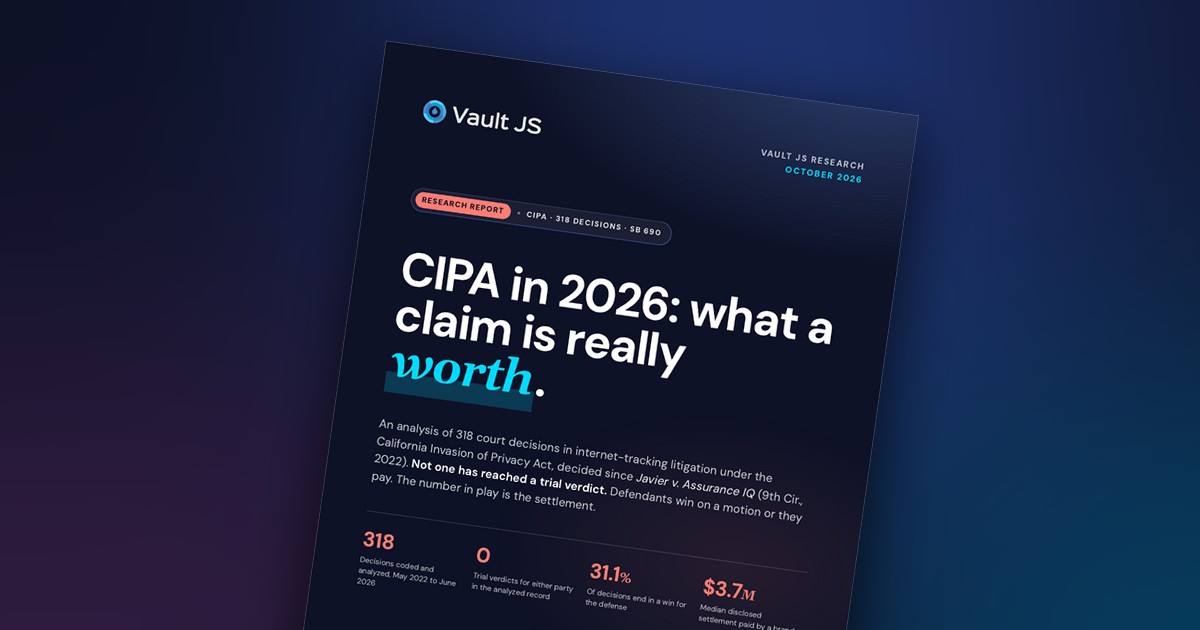
We analyzed every internet-tracking decision under CIPA since 2022. None is a trial verdict, the defense wins 31.1% of the time, and the median disclosed...