

The New Costs of an Old Law
The Video Privacy Protection Act of 1988 (VPPA) is an old law that is suddenly driving multimillion-dollar settlements for disclosing to third parties which video titles people have watched. Vault uncovers any mechanism that could send viewing data and user identity off your site, so your legal and engineering teams can act.

Hundreds of Lawsuits per Year
By early 2025, some 200+ VPPA lawsuits were being filed annually, making the law a costly risk for companies with video content. VPPA liability for sharing video titles remains unsettled, making litigation unpredictable. Vault makes visible where your video players are and which vendors are receiving their data.

Multi-Million Dollar Settlements
Plaintiffs' attorneys have been busy filing complaints many companies are forced to settle. In many cases, the settlements end up in the millions, including AARP ($12.5 million) and BuzzFeed ($9 million), both involving the sharing of video-viewing data.

Statutory Damages Pile Up
The VPPA provides for liquidated damages of $2,500 for each violation. If 100,000 users are affected, that’s up to $250 million liability on paper, which is why companies prefer to settle.
How Vault JS Supports VPPA Compliance

Pixel and Tracker Surveillance
Vault captures pixels as they send video title data.

Automatic ID & Video Correlation
Vault correlates user identifiers with video content in your data flows.

Be Less Attractive to Plaintiffs’ Attorneys
We identify vendors who are likely to be implicated by plaintiffs' attorneys.

Mass Arbitration Mitigation
Early detection helps you avoid lawsuits and arbitrations.

Comprehensive Evidence for Defense
In a VPPA claim, you have the data to fight or settle smartly.
Key VPPA Compliance Capabilities
Video Content Tagging
Vault’s Video Content Tagging identifies embedded video players, tracking pixels, and event parameters associated with video views, detecting when viewing activity may be transmitted to third parties, reducing VPPA exposure.
Meta Pixel VPPA Scanner
Our Meta Pixel VPPA Scanner analyzes whether Meta Pixel or similar tracking tools transmit video-viewing activity, page URLs, or user identifiers to third parties. It helps identify potential VPPA exposure before unlawful disclosure claims arise.
Identify High-Risk Vendors
Identify vendors who might already know the user’s identity, such as Google or Meta. In these cases, merely transferring the title could put you at risk.
Alerts for Login+Video Combos
Vault flags scenarios where authenticated users view video content while tracking technologies are active, and helps identify situations where identifiable viewing activity could be disclosed to third parties, thus increasing VPPA risk.
Make weak claims easier to dismiss
Vault captures the full picture of your site’s data flows — before you need it. We show you exactly what was and wasn’t transmitted, replacing uncertainty with defensible documentation.
Vault JS Compliance Management Resources
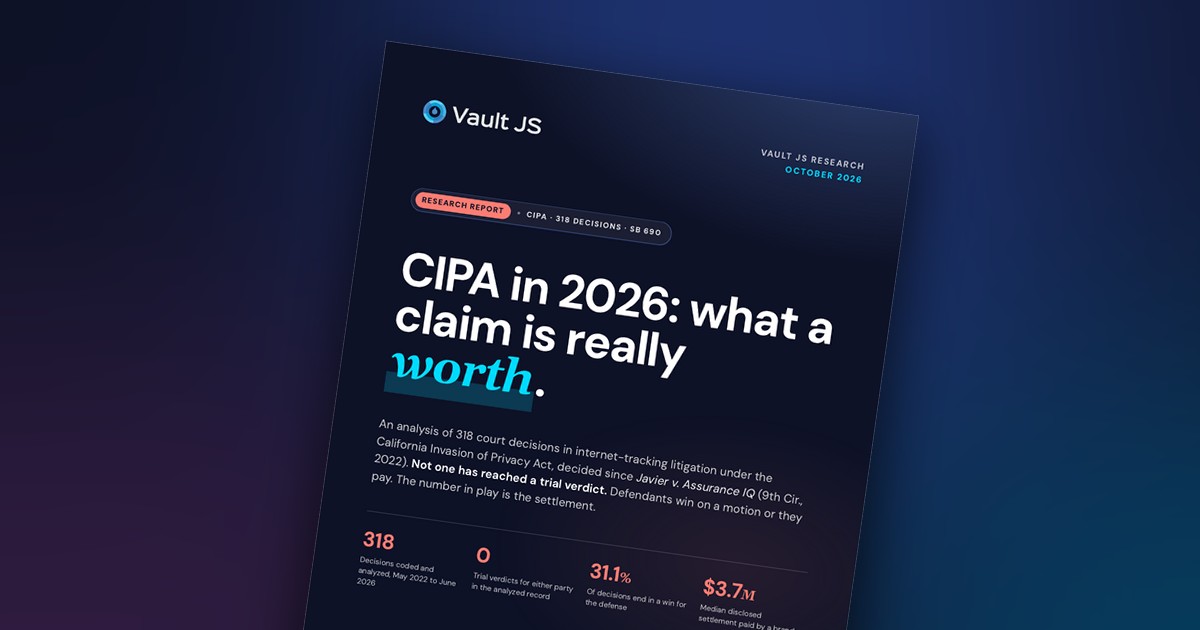
CIPA in 2026: 318 decisions, zero trial verdicts, and what a claim is really worth
We analyzed every internet-tracking decision under CIPA since 2022. None is a trial verdict, the defense wins 31.1% of the time, and the median disclosed...

Four Takeaways From Our Conversation With CalPrivacy’s Tom Kemp
CalPrivacy Executive Director Tom Kemp on vendor validation, GPC enforcement sweeps, cross-device opt-outs, and reading settlements as guidance.
Read More
Show Your Work: Privacy’s Shift to Continuous Assurance
Regulators are shifting from "do the work" to "show your work." In a recap of our webinar with PwC's Jake Meek, this blog discusses the...
Read More