
Mobile privacy enforcement is going global
By Karel Kubicek | November 18, 2026
For years, privacy enforcement has been a story about websites: cookie banners, tracking pixels, and the session-replay scripts that load before anyone clicks “Accept.” Mobile apps sat in the background, governed by the same laws but rarely at the center of a regulator’s decision.
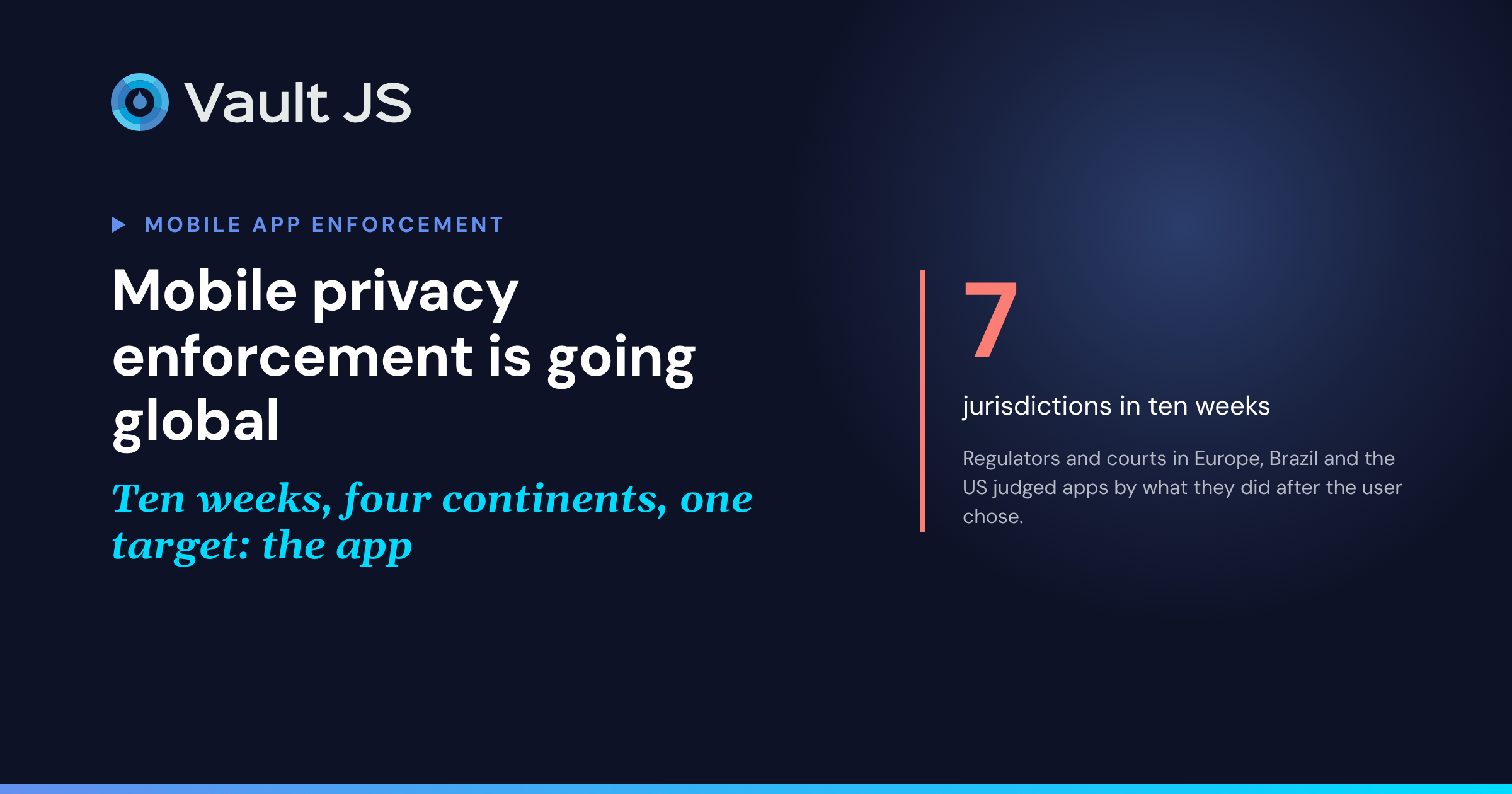
That has changed. Between late August and early November 2026, regulators and courts in France, Italy, Denmark, Brazil, Texas, Massachusetts, and California each issued decisions that turn on what a mobile app does with personal data. They did not coordinate. They applied different statutes, from the French Data Protection Act and the GDPR to the CCPA and state consumer-protection law. Yet they reached the same conclusion: what a user chooses inside an app has to control what the app actually does.
Taken together with Norway’s Xandr fine, covered below, these decisions carry well over €40 million in fines and settlements, before counting General Motors’ $220 million multistate settlement over its connected-car app. The amounts matter less than the pattern. Regulators are no longer looking only at the privacy policy or the consent screen. They are looking at what the app reads, writes, and transmits after the user has made a choice.
That shift follows the users. For many consumers, most of their online time is now spent in apps rather than browsers. Apps also sit closer to the most sensitive data a person generates: precise location, contacts, payment and banking activity, health signals, and the behavior of children and teenagers. A tracker in an app is often closer to the person than a tracker on a website.
The decisions at a glance
Seven jurisdictions acted on mobile apps between August 24 and November 10, 2026.
| Decided | Company and authority | Amount | What the app did |
|---|---|---|---|
| Nov 10, 2026 | Coop Danmark, Dagrofa Datatilsynet, Denmark |
Serious criticism, no fine | Used location and in-app tracking without consent |
| Oct 29, 2026 | Lyft Attorney General, California |
$1.8M | No in-app opt-out from the sale of personal data |
| Oct 29, 2026 | General Motors 36 attorneys general (35 states and D.C.) |
$220M | Sold driving and location data from its connected-car services |
| Oct 22, 2026 | FNAC CNIL, France |
€7M | Tracker kept running after “Continue without accepting” |
| Sep 10, 2026 | TikTok District Court, Travis County, Texas |
Liability found, penalty pending | Misrepresented how Restricted Mode protects minors |
| Sep 3, 2026 | BBVA Garante, Italy |
€5.5M | Kept sending in-app marketing after the user switched it off |
| Aug 24, 2026 | TikTok ANPD, Brazil |
BRL 153.8M (about €24M) | Processed teenagers’ data without a valid legal basis or working age checks |
Pattern 1: the choice has to reach the code
The clearest signal comes from Europe, where three regulators judged apps by what happened after the user said no. Each app asked for a choice, through a consent banner, a consent management platform (CMP), or an in-app setting. In each case, the choice did not control what the app did.
FNAC, France (€7 million). The CNIL found that FNAC Direct and FNAC Darty Participations et Services jointly operated a tracker in the FNAC mobile app. It read and wrote information on users’ devices for product personalization, recommendations, and algorithm training. The tracker kept running after users tapped “Continue without accepting.” Because those purposes were commercial rather than strictly necessary, Article 82 of the French Data Protection Act required prior consent. The CNIL imposed €7 million in fines, together with a compliance order backed by a €10,000-per-day penalty. The consent screen looked right. The app’s behavior did not match it.
BBVA, Italy (€5.5 million). The Garante’s case began with one customer. They disabled commercial notifications in the BBVA banking app, objected to marketing, and kept receiving in-app promotions. The Garante found that BBVA’s Italian branch failed to honor the objection and lacked the organizational measures to make the setting work. A single ignored toggle led to a fine of €5,508,000.
Coop Danmark and Dagrofa, Denmark. In parallel decisions, Denmark’s Datatilsynet examined two grocery chains’ shopping apps. Coop could not rely on contractual necessity or legitimate interests to process device location in its Scan & Betal self-checkout feature and for marketing; consent was required. Dagrofa could rely on legitimate interests for basic analytics, but not for location-based store detection or in-app interaction tracking. The authority also criticized Coop’s red “Accept all” and white “Accept selected” buttons as nudging that undermined free consent. Neither decision carries a fine, but both set out what a Danish app may collect without asking.
In all three cases, the regulator compared the user’s choice with what the app did next. Deploying a CMP or a privacy toggle is the easy part. The hard part is configuring it correctly and making sure every SDK and back-end system honors the choice. That is where these companies failed. Postscript: on November 14, 2026, after the decisions covered here, Italy’s Garante announced an €805 million fine against Meta because the Facebook app for Android accessed users’ photo galleries without specific, informed consent. It is far larger than any fine in the table.
Pattern 2: if the service lives in the app, so must the opt-out
In the United States, the theory is different but the target is the same.
Lyft, California ($1.8 million). Riders and drivers can use Lyft only through its app. The California Attorney General found that the app had no native way to opt out of the sale of personal information. Users were sent to a mobile browser, made to click through several screens, and asked to log in and identify themselves again before they could exercise a right the CCPA says must be easy to use. The settlement requires $1.8 million in civil penalties and an in-app opt-out. The rule that follows is plain: if the service runs in the app, the privacy controls must be in the app too.
General Motors, 36 attorneys general ($220 million). On the same day, General Motors settled with the attorneys general of 35 states and the District of Columbia over the sale of driving behavior and location data to data brokers, which then reached insurers. Massachusetts’ share alone is $5.7 million. The states focused on how drivers were enrolled in GM’s Smart Driver program, often at the dealership, and on whether they understood what they agreed to. They also allege that the OnStar app told more than 370,000 drivers they were not enrolled while their data was still being collected. The settlement requires affirmative express consent, limits on the driving data GM collects, and a privacy program with internal and external assessments. For any company whose app collects telemetry, it shows how quickly an enrollment screen can become evidence.
Pattern 3: young users raise the stakes
Among the decisions in the table above, the largest regulatory fine came from Brazil, and it concerned teenagers.
TikTok, Brazil (BRL 153.8 million, about €24 million). Brazil’s ANPD found that Bytedance Brasil processed children’s and adolescents’ data in the TikTok app without a valid legal basis. It also found that TikTok’s age-verification and preventive measures were not effective, and that the company could not show they worked. The ANPD imposed fines of BRL 153,769,671.33 and ordered TikTok to delete data of 13- to 18-year-olds whose parental authorization is not in order. TikTok must also notify the third parties that received that data, under a daily penalty for non-compliance.
TikTok, Texas. Two weeks later, a Travis County court granted Texas partial summary judgment. It held that TikTok misrepresented its content-moderation practices and how well its Restricted Mode protects minors. No penalty has been set yet. Discord faced similar pressure in both countries. In August, Brazil’s ANPD ordered it to suspend its Go Live video feature. In Texas, Discord agreed to an injunction that extends its UK age-assurance protections to Texas users.
The theme is consistent: when minors use an app, regulators expect safeguards that work on real devices, not policies that only describe them.
Next: the SDKs inside the app
The decisions above target the companies that publish apps. The next wave targets what those apps embed. Plaintiffs’ firms in California, already experienced in website-tracking litigation under CIPA, have filed class actions over third-party SDKs. The defendants include location SDKs (InMarket, Verve/PubNative), product-analytics SDKs (Mixpanel, Amplitude), and the Meta and TikTok SDKs embedded in wellness and addiction-recovery apps (Monkey Taps, Koby Empire). A separate complaint targets Google’s AdMob over children’s Android apps. None of these cases has been decided, and none has produced a dollar figure yet. Their theory, however, is the one that website pixel cases established: an embedded third-party component that collects data without consent can act as a wiretap or a pen register.
Regulators are following the same supply chain. In October, Norway’s Datatilsynet fined Xandr NOK 92 million for its role in distributing Grindr users’ data through real-time bidding. We covered that decision in our earlier post on the Xandr fine.
What app teams should do now
A compliant consent screen no longer protects an app on its own. Each of these decisions compared what the user chose with what the app actually did. Teams that ship mobile apps should be able to answer four questions with evidence, not assumptions:
- Does a “no” stop the traffic? Test the app on a real device after declining consent, and record which SDKs still read identifiers, write to storage, or call third-party endpoints (FNAC, Coop, Dagrofa).
- Do in-app settings reach the back end? A disabled notification or marketing toggle has to change what the systems behind the app send (BBVA).
- Is every privacy right available where the service is used? If customers use the service only through the app, the opt-out has to be in the app (Lyft).
- Which SDKs receive location, identifiers, or data about minors, and under what basis? This applies especially to location, analytics, and advertising SDKs (GM, TikTok, and the pending US class actions).
Website tracking took years to move from regulatory guidance to enforcement, and then to mass litigation. On mobile, that shift is happening across jurisdictions at once, and within a single quarter.
Sources
- CNIL, FNAC: announcement and decision on Legifrance
- Garante, BBVA: decision of September 3, 2026
- Datatilsynet: Coop Danmark decision and Dagrofa decision
- California Attorney General, Lyft: press release
- General Motors: Washington Attorney General and Massachusetts Attorney General press releases
- Texas Attorney General, TikTok: press release
- ANPD, TikTok: Migalhas report on the decision
This article describes published regulatory decisions and court rulings and what they mean in practice for teams that operate mobile apps. It is not legal advice. Decisions about your own legal basis, consent flows or opt-out mechanisms should be made with your counsel.
Recent Posts
What Are the Biggest Privacy Fines and How Can Businesses Avoid Them?
The largest privacy fines and settlements on record, updated through November 2026, plus the smaller actions against ordinary brands over how their websites and apps...
Read More
The Xandr fine: responsibility does not travel with the bid request
Norway's largest data protection fine went to the ad exchange, not the app. Why Xandr's assumed-consent defense failed, and what app owners should check this...
CIPA in 2026: 318 decisions, zero trial verdicts, and what a claim is really worth
We analyzed every internet-tracking decision under CIPA since 2022. None is a trial verdict, the defense wins 31.1% of the time, and the median disclosed...