
How Mature Is Your Organization’s Martech Privacy and Security Posture?
By Josh Manion, CEO, Vault JS | December 1, 2021
Key Takeaways
Editor’s note: When this was published, Vault JS used the term “digital marketing assurance.” Today we call this independent privacy compliance monitoring for web, mobile, and CTV, with security monitoring for third-party scripts. See What Is Privacy Compliance Monitoring?
- 59% of companies have experienced a data breach caused by a third-party vendor, and most organizations provide less customer privacy protection than the volume of Martech tools on their sites warrants. The gap between the number of third-party JavaScript tags with access to customer data and the level of oversight applied to those tags is where compliance and security risk concentrates.
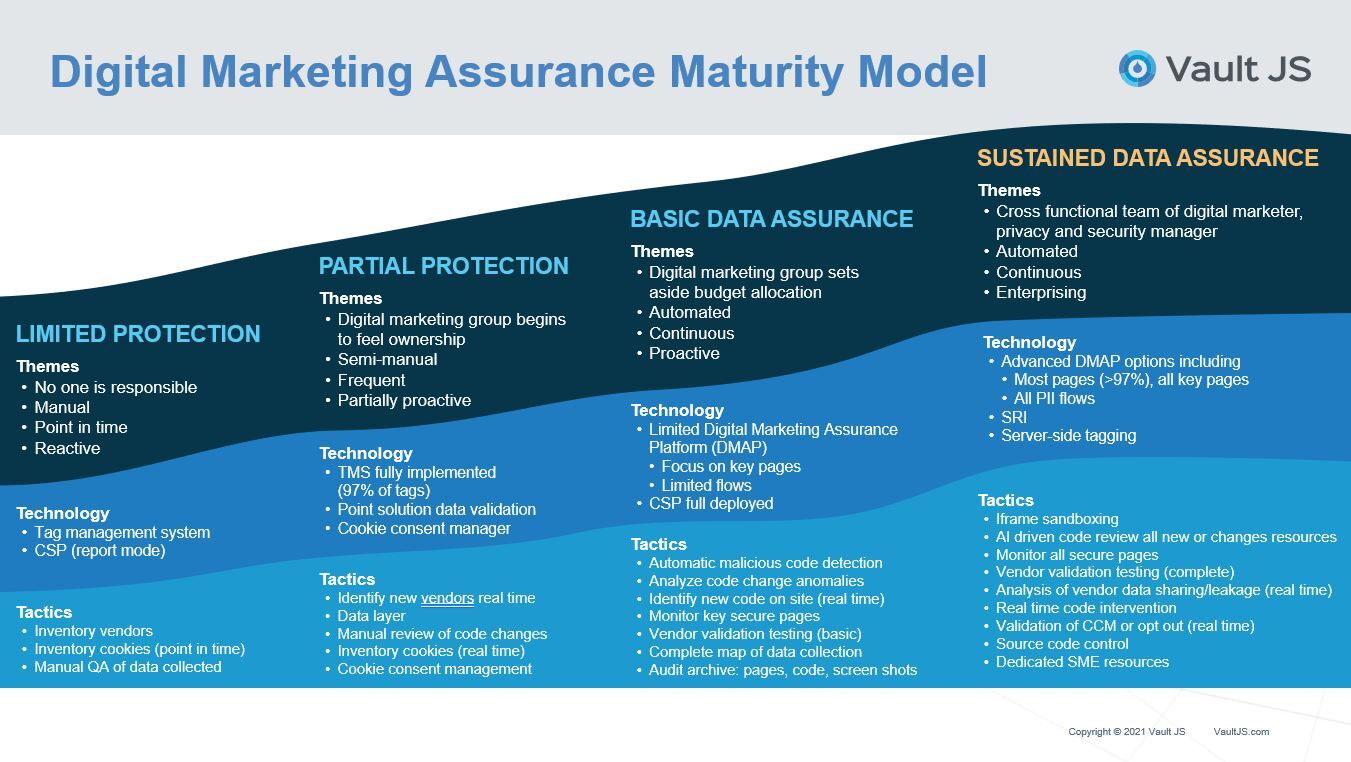
- The Digital Marketing Assurance Maturity Model defines four levels of protection: limited, partial, basic data assurance, and sustained data assurance. Most enterprises operate at the lower levels, relying on one-time audits or incomplete visibility into their tag ecosystems. Sustained data assurance requires continuous, automated monitoring of all data collection and distribution across the entire tag ecosystem.
- Reaching sustained data assurance requires a cross-functional team, full PII flow visibility, and deployed Content Security Policy (CSP) and Subresource Integrity (SRI). One-time audits are no longer sufficient. Organizations at the highest maturity level maintain real-time analysis of code changes, automated vendor validation, and best practices for tag management and cookie consent across all digital properties.
Is Your Company Leading or Lagging in Protecting Your Customers’ PII?
Martech tools fuel your marketing, but you also need to ensure that your use of those tools is not allowing your customers’ personally identifiable information (PII) to fall into the wrong hands.
The risk is greater than you might think. In fact, 59% of companies have experienced a data breach caused by a third party vendor.
So how do you know if your organization is at a high or low risk? What are the steps necessary to best protect customer PII? Our Digital Marketing Assurance Maturity Model was designed to provide this analysis and roadmap.
What Are the Four Levels of Digital Marketing Assurance Maturity?
For most companies, the amount of customer privacy protection they provide is less than adequate given the number of martech tools and third-party JavaScript tags that have access to customer data. Our Digital Marketing Assurance Maturity Model shows the steps enterprise level companies should aspire to reach, from limited protection to partial protection, to basic data assurance and, finally, to sustained data assurance.
Every effort you make to protect your online users can be critically important to maintaining their trust, and your reputation. Even small measures can have a profound effect on your business.
What Does Sustained Data Assurance Require?
The highest level of our Digital Marketing Assurance Maturity Model is Sustained Data Assurance. The question should not be “should we get there” but “how can we get there?” And what are the themes, technologies and tactics that should be in place?
First of all, you need the right team in place—a cross-functional team of digital marketing, privacy and security managers, working together. You also need:
- An automated, continuous and enterprising approach. One-time audits are no longer sufficient for protecting confidential data.
- Full visibility of all data collection and distribution.
- An advanced Digital Marketing Assurance Platform monitoring all flows of Privately Identifiable Information (PII) throughout the entire tag ecosystem.
- Real-time analysis of changes and code intervention as necessary.
- Fully deployed Content Security Policy (CSP) and Subresource Integrity (SRI).
- Best practices in place for vendor validation, tag management, cookie consent, security and more.
Each of the levels requires effort and guidance to reach. But helping companies achieve sustained data assurance is why VaultJS was created. Call us and we will help you evaluate your current level of digital marketing assurance maturity, and outline the steps that will help you elevate your organization.

Josh Manion
CEO and Co-Founder, Vault JS
Before founding Vault JS, he created and led Ensighten, pioneering the tag management category and earning patents for innovations in how third-party JavaScript is managed on enterprise websites. That close-up view of the security and privacy risks embedded in the Martech ecosystem led directly to the creation of Vault JS.
Recent Posts
CIPA in 2026: 318 decisions, zero trial verdicts, and what a claim is really worth
We analyzed every internet-tracking decision under CIPA since 2022. None is a trial verdict, the defense wins 31.1% of the time, and the median disclosed...

Four Takeaways From Our Conversation With CalPrivacy’s Tom Kemp
CalPrivacy Executive Director Tom Kemp on vendor validation, GPC enforcement sweeps, cross-device opt-outs, and reading settlements as guidance.
Read More
Show Your Work: Privacy’s Shift to Continuous Assurance
Regulators are shifting from "do the work" to "show your work." In a recap of our webinar with PwC's Jake Meek, this blog discusses the...
Read More